
Herniated, Bulging & Degenerative Disc Relief in Sarasota
Discs don’t wear out on their own. Something is loading them wrong.
Non-surgical options for neck and lower back disc problems, built on what your X-rays actually show.
What’s actually going on with your disc
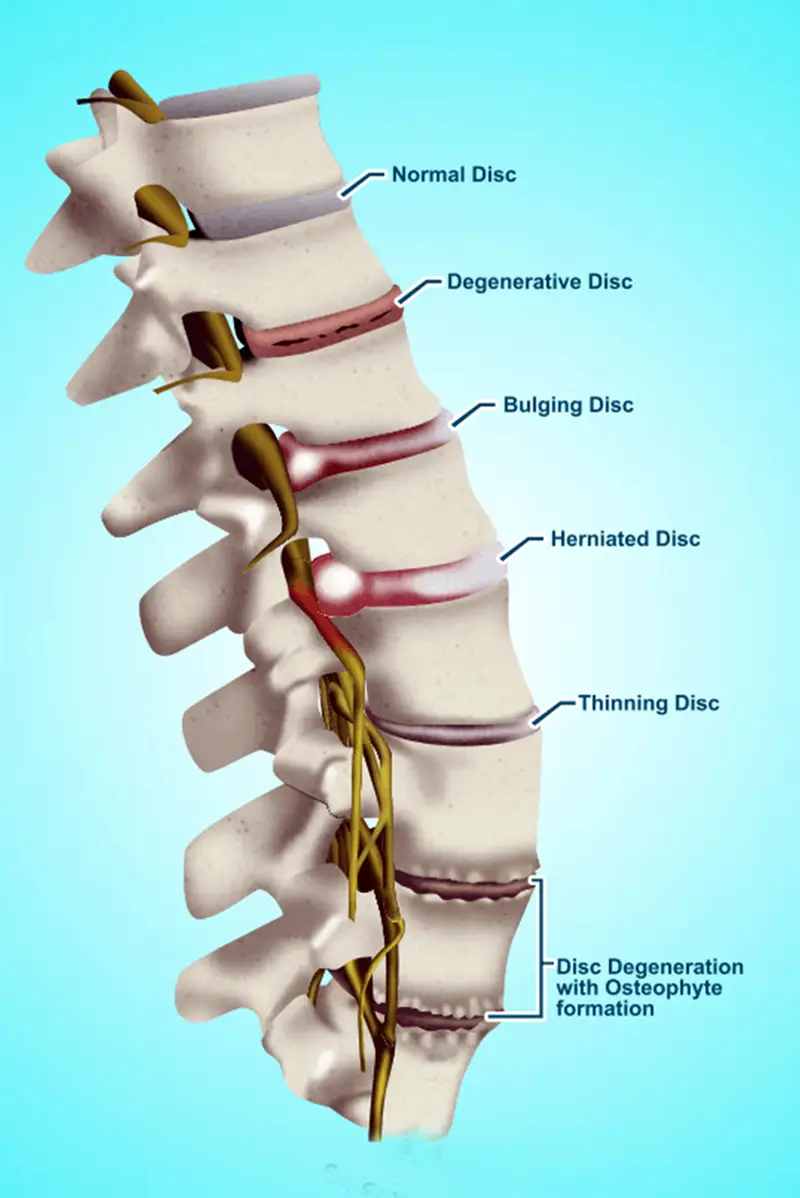
Your discs are the spacers between your vertebrae. Think of each one like a jelly donut: a tough outer ring with a softer, gel-like center. They absorb shock, let your spine move, and keep space open for the nerves exiting on each side.
When your spine loses its normal curves, the load stops spreading evenly. The discs at those levels take more pressure than they were built for, day after day. Over time that can look like a bulge (the disc pushes outward), a herniation (the inner gel pushes through the outer ring), or degeneration (the disc dries out and loses height).
The disc itself is only half the story. The bigger issue is what it’s pressing on. When a disc crowds a nerve, you may feel it far from the disc: down the arm into the hand from the neck, or down the leg into the foot from the lower back.
does this Sound familiar?
- Sharp or burning pain that shoots into an arm or leg
- Numbness, tingling, or weakness in your hands or feet
- Pain that gets worse sitting, coughing, or sneezing
- An MRI or X-ray report that mentions a bulge, herniation, or degenerative disc disease
How we find the cause: Alignment, movement, spinal Damage
Every new patient gets the same thorough starting point. We test your spine three ways:
Alignment
Posture checks, balance scales, and eyes-closed stability testing to see how your body is carrying itself.
movement
Range of motion through your whole spine, plus how each segment moves on its own.
spinal Damage
Full-spine digital X-rays can show disc changes, arthritis, bone spurs, or old injuries that may have created a stress pattern.
With disc issues, your digital X-rays show us disc height at every level, the curve that is loading those discs, and any arthritis or bone spurs around them. If you already have an MRI, bring it.
From the side, your spine should have smooth, healthy curves. We measure yours and chart it against normal:
MildUp to 15% loss of curve
Moderate15–30% loss of curve
SevereMore than 30% loss of curve
Your PostureRay X-Ray Report shows you exactly where you stand, and we re-measure along the way so you can see progress, not just feel it.
How we help disc problems
Depending on which disc is involved and what your exam shows, your plan may include:
Spinal Decompression
If your exam shows a potential disc bulge or herniation, or if we visualize degeneration on X-ray, non-surgical decompression on our Chattanooga Triton 6M traction table is used to gently create space between the vertebrae and take load off the disc and the nerves around it. That space may help a bulging or herniated disc settle back and give a degenerating disc room to rehydrate. We use it for both the neck and lower back.
Corrective Chiropractic Care
Decompression creates space. Corrective adjustments, spinal hygiene exercises, and/or orthotics work on the alignment that overloaded the disc in the first place, so you’re not right back here in a year.
NeuFit (nervous system + fitness)
Disc problems often leave muscles shut down or locked up to protect you, and that pattern can stick around after the pain eases. The Neubie helps us find those spots and rebuild strength around the injured area.
PLACEHOLDER – YOUR STORY: Share a patient story (with permission) of someone who came in with a disc problem and avoided surgery, or why you added decompression to the practice. – Dr. Alex
What to expect
Feeling better and being fully better aren’t the same thing. Most people notice changes early on. Truly stabilizing a spine that’s been out of alignment for years can take up to 6-12 months of consistency… That doesn’t mean 6-12 months to feel better, it just means that your body needs time to hold the correction so it doesn’t slide back.
Will it hurt? Changing a spine that hasn’t moved in years can feel like a workout at the beginning. If you feel it, it’s usually in the first couple of weeks, and we adapt our technique to what works best for you.
When to get emergency care: Go to the ER right away if you have loss of bowel or bladder control, numbness in the groin or inner thighs, or weakness in a leg that is getting worse quickly. If your exam points to something that needs an MRI or a surgical consult, we will tell you straight and help you get there.
What our patients say
My son works construction and tweaked his back…. Took him straight away to someone I trust 100%, Dr. Alex!! Thankfully all is well and he was able to get adjusted and back on track. Highly recommend!!
★★★★★ Google review
Frequently asked questions
Can a herniated disc get better without surgery?
Many can. A large share of disc herniations improve with conservative care, and surgery is usually a last resort rather than a first step. Your exam tells us where you likely stand, and we’ll be honest either way.
Do I need an MRI first?
Not always. Digital X-rays and a thorough exam are our starting point. If your symptoms or findings call for an MRI, we’ll tell you and help you get one ordered.
Is decompression the same as an inversion table?
No. Inversion hangs you upside down and pulls on everything at once. Decompression is controlled and targeted to a specific level of your spine, and cycled so your muscles do not guard against it.
How many decompression sessions will I need?
It depends on the disc, how long it’s been an issue, and how you respond. After your exam, we’ll give you a clear number up front. We don’t like surprises either.
Where are you located?
We’re at 5250 17th St, Unit 101, on the corner of 17th & Honore, centrally located between University and Fruitville and about 5 minutes from I-75 and UTC. We see patients from Sarasota, Bradenton, and Lakewood Ranch.
Ready to find out what’s going on?
Your new patient exam includes a full consultation, nerve scans, digital X-rays, and a PostureRay report, so you leave knowing exactly where you stand.
Related: Lower Back Pain · Sciatica & Nerve Pain · Headaches · Whiplash