
One of the most common questions I get from people in Sarasota who are looking into spinal decompression is some version of this: “My MRI says my disc is thinning. Can decompression actually bring that back?”
It’s a fair question, and you deserve a straight answer. Here’s what the research shows, what it doesn’t show, and how I think about disc height when someone comes into our office in Sarasota.
What “disc height” means and why it matters
Between each vertebra in your low back sits a disc: a tough outer ring with a gel-like center. A healthy disc acts like a spacer and a shock absorber. It keeps room open for the nerves that exit your spine and down into your hips and legs.
Over time, from years of sitting, heavy lifting, old sports injuries, or just gravity, discs can lose water and flatten. On an x-ray or MRI this shows up as a narrower space between two vertebrae. Less space can mean more pressure on the joints behind the disc and less room for the nerve, which is one reason people with disc problems may feel low back pain, sciatica, or numbness and tingling down the leg.
Discs don’t have much of their own blood supply. They get most of their nutrition by soaking up fluid when pressure comes off them, a bit like a sponge. That detail is the whole idea behind decompression.
How non-surgical spinal decompression works
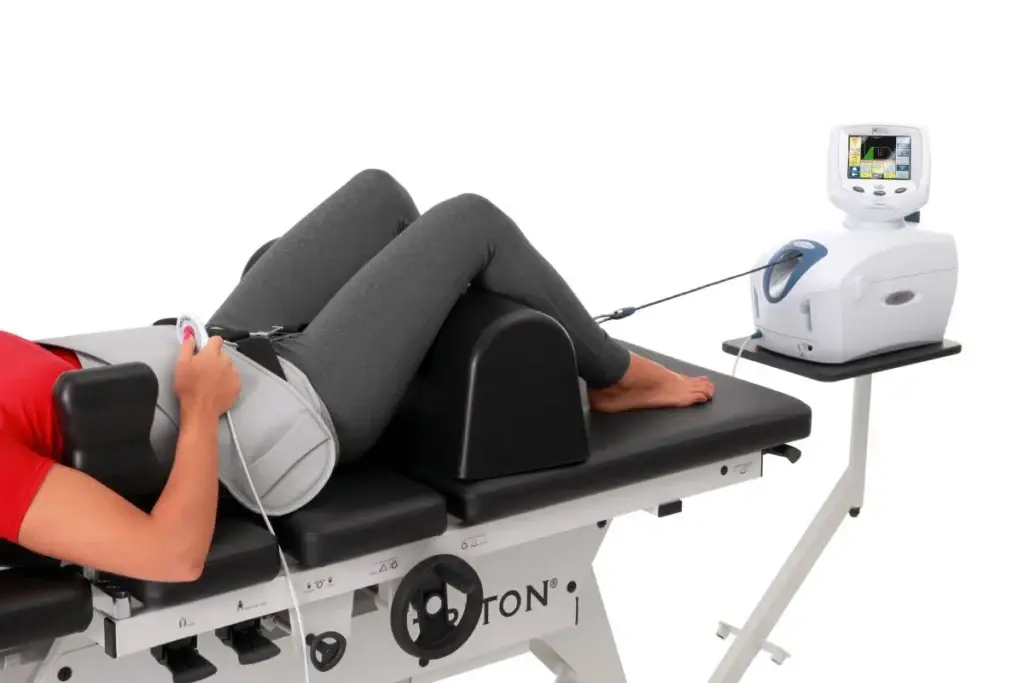
Non-surgical spinal decompression uses a computer-controlled table to apply a slow, cycling pull to a specific level of your spine. In our office that’s a Chattanooga Triton table. You lie comfortably, fully clothed, with a harness around your hips and torso. The table gently lengthens the spine, holds, and then eases off, over and over, for the length of the session.
The goal is to briefly reduce the pressure inside the disc. When that pressure drops, the disc may draw in water and nutrients, and a bulging portion of the disc may be encouraged back toward center. It isn’t the same as hanging upside down or a basic traction belt. The pull is gradual and cycled so your back muscles don’t guard against it.
What the research says about restoring disc height
The study most people point to was published in 2010 in BMC Musculoskeletal Disorders by Apfel and colleagues. They looked back at 30 patients (average age 65) with chronic low back pain from disc herniation or degeneration. Each completed 22 decompression sessions over about six weeks, and the researchers compared CT scans taken before and after.
What they found:
- Average disc height went from 7.5 mm to 8.8 mm, an increase of about 1.3 mm.
- Average pain dropped from 6.2 to 1.6 on a 0 to 10 scale.
- People whose discs gained more height tended to report more pain relief.
A millimeter might not sound like much, but in a space that’s only 7 or 8 millimeters to begin with, it’s a meaningful change.
Now the honest part. This was one small study. It had no control group, it looked back at records instead of following people forward, and it didn’t track how long the changes lasted. So it’s encouraging, not proof. Anyone who tells you decompression is guaranteed to “regrow” your disc is overselling it. What I can tell you is that there’s a reasonable scientific basis for it, and that the people who respond well usually feel it in how they move and sleep within the first few weeks.
Who is a good fit, and who isn’t
Decompression tends to make the most sense for people with:
- Bulging or herniated discs in the low back
- Degenerative disc changes or disc thinning seen on imaging
- Sciatica or leg pain that traces back to a disc
- Back pain that hasn’t improved with rest, stretching, or medication
It’s not for everyone. Recent fractures, spinal fusion hardware, advanced osteoporosis, pregnancy, and certain other conditions can rule it out. That’s why I don’t start anyone on the table without a full exam and imaging (usually digital x-rays taken right here in the office), so we know exactly which level we’re working with and whether decompression is the right tool at all. If it isn’t, I’ll tell you and point you in the right direction.
Making the gains stick
Taking pressure off a disc is only half the job. If you go right back to the same sitting posture, the same lifting habits, and a weak core, the disc goes right back under the same load. That’s why decompression in our office is paired with chiropractic care and simple strength and mobility work you can keep doing on your own. Many of our patients are golfers, pickleball players, and people who just want to get through a day of yard work, and the goal is the same for all of them: get you moving well enough that your back holds up between visits and after we’re done.
Common questions from Sarasota patients
Does Non-Surgical Spinal Decompression hurt?
Most people find it relaxing. You’ll feel a gentle stretch through your low back. Some people fall asleep on the table.
How many sessions will I need?
It depends on what your exam and imaging show. Yours should be built around your findings and re-checked along the way.
Can Non-Surgical Spinal Decompression help me avoid back surgery?
For many people with disc-related pain, a conservative approach is a reasonable first step before surgery. Some situations do need a surgeon, such as loss of bladder or bowel control or rapidly worsening leg weakness. If I see signs like that, I’ll refer you out right away.
Do you see patients from Lakewood Ranch and Bradenton?
Yes. We’re at the corner of 17th Street and Honore Avenue in Sarasota, an easy drive from Lakewood Ranch, University Park, and Bradenton.
Find out if Non-Surgical Spinal Decompression fits your back
If you’ve been told your discs are thinning or bulging and you want to know whether a non-surgical option makes sense, the first step is an exam. We’ll look at your history, check how you move, take x-rays if needed, and give you a clear answer on whether spinal decompression is a good fit.
Schedule your first visit with Dr. Alex Lee at Circadian Chiropractic & Sport in Sarasota.
Source: Apfel CC, et al. Restoration of disk height through non-surgical spinal decompression is associated with decreased discogenic low back pain: a retrospective cohort study. BMC Musculoskeletal Disorders. 2010;11:155. Read the study. This article is for general education and isn’t a substitute for an individual exam.

About Dr. Alex Lee
Dr. Alex is a Life Chiropractic College West graduate and former D1 baseball player who owns Circadian Chiropractic & Sport in Sarasota, Florida. He helps families and athletes in Sarasota, Bradenton, and Lakewood Ranch.
new patient special
$47 new patient exam
Consultation, full exam, X-rays (if necessary), your first adjustment, a report of findings, and care recommendations.
$47 new patient exam is for cash-pay new patients. Not valid for insurance-billed, Medicare, Medicaid, or auto-injury/personal injury visits. The patient and any other person responsible for payment has a right to refuse to pay, cancel payment, or be reimbursed for payment for any other service, examination, or treatment that is performed as a result of and within 72 hours of responding to the advertisement for the free, discounted fee, or reduced fee service, examination, or treatment.