
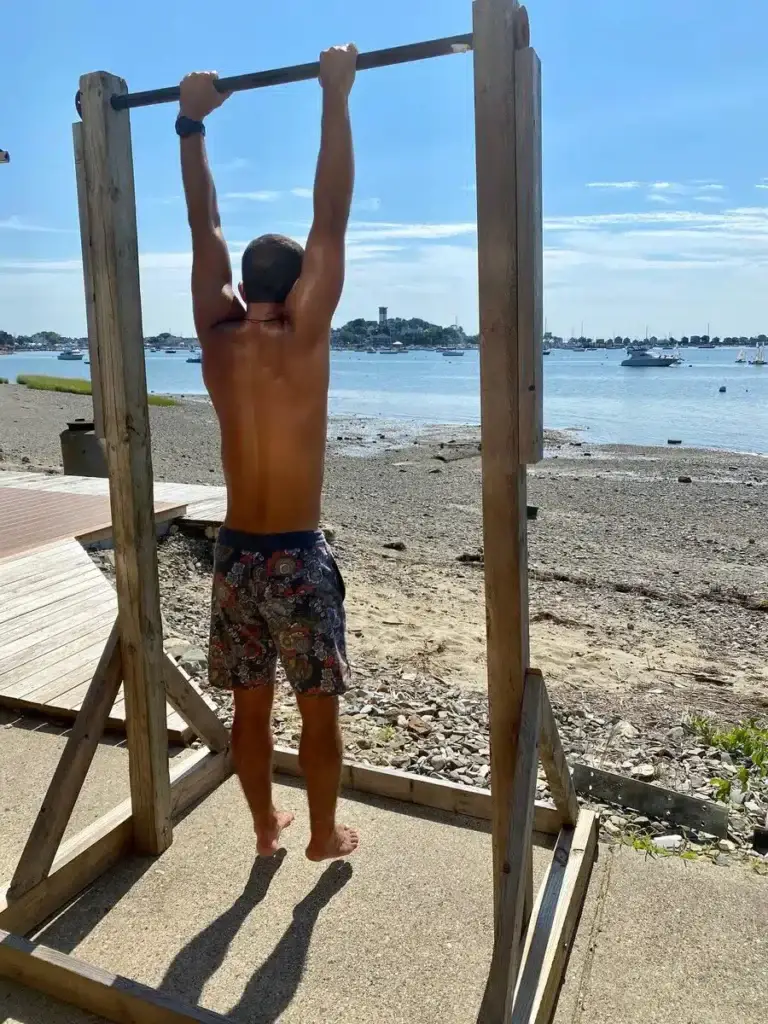
By Dr. Alex Lee
I wrote this piece years ago for Just Fly Sports. I still hang almost every day for grip strength and shoulder health, and the ideas hold up, so I’ve trimmed it down to share here. – Dr. Alex Lee
Every hand tells a story. Each hand, like each foot, has 26 bones. Together that’s more than half the bones in your body. All those small joints help you feel the world in detail and send that information to your brain and nervous system. So it makes sense to keep your hands strong.
The simplest way I’ve found to do that is also the most primal: hanging. This post covers three things: what hanging does physically, the mental challenge, and how to start.
What Hanging Does for Your Shoulders and Grip
The shoulder is a ball-and-socket joint built for a huge range of motion. That includes reaching overhead and holding your whole body weight through your arms.
One part of the shoulder blade, the acromion, hooks upward toward your head. Wolff’s Law says bone adapts to the stress you put on it: use it or lose it. If you rarely reach overhead, that hook may slowly angle downward. That narrows the space at the front of the shoulder (the coracoacromial arch) and can squeeze the bursa and rotator cuff tendons underneath. That squeeze can lead to shoulder pain and stiffness, and most of all, weakness.
The good news is that hanging may help restore that space, because your body adapts to what you ask of it. For a deeper dive, read John Kirsch MD’s book Shoulder Pain? The Solution & Prevention.
Hanging is a foundation that harder movements are built on. If you can’t hang, other movements get harder and can become riskier. If you can hang, your performance in your sport often improves without training it directly. You use what you learned in kindergarten every year after. Don’t skip the basics.
The Real Reason I Hang: Breath and Resolve
This is the meat and potatoes. If you’re only hanging for grip or shoulder health, you’re missing the bigger picture.
Say I set a timer for three minutes. I grab the bar and relax. Eventually my hands and forearms tell my brain they’re tired, and my body tells my mind it’s time to let go. Then:
- Panic sets in
- My breathing gets erratic
- My hands start to sweat
- My mind tries to convince me it’s okay to stop
The most change happens from that point on. When you think you’ve hit failure, there’s usually at least another minute left in the tank.
That’s where I dig into what I call “that something”: resolve, a muscle that has to be flexed. A friend and client called it an active meditation. You can carry it into the rest of your day when physical, mental, or emotional adversity shows up. I agree with that.
Most days I picture my family and my “why,” which is what I’d do to provide for them and protect them. Some days I hang just to get out of my head and into my body. Whatever comes up, I let it flow and let it go.
How to Start Hanging
I’ve written plenty, so here’s my advice: don’t overthink it.
- Find somewhere safe to hang: a bar, rings, or a sturdy tree branch
- Start with at least 30 seconds, 3 times a week. Keeping your feet partly on the ground is fine.
- Work up to 3 minutes a day, with 5–7 minutes a day for some whose lives demand such an input (not a typo), split into as many sessions as you need
- Breathe through your nose as calmly as you can
- Listen to your body and don’t push through joint pain
A few protocols that I use:
- Straight hang: 90 seconds to 5+ minutes (again, not a typo). When you hit failure, pause the timer, take 3 breaths, and get back on.
- Ladder: 5 seconds on, 5 off, 10 on, 5 off, 15 on, 5 off, and so on, up to 40–45 seconds on
- Intervals: 1 minute on, 1 minute off, 4–8 sets
- Single arm: 20 seconds left, 20 seconds right, switching continuously, 6–12 sets
Tips:
- Grip with palms facing forward or facing each other, and use your thumbs
- Set up “anchors” at home, at work, or outside so hanging becomes a habit, like keeping your toothbrush by the sink
- Don’t compare your time to anyone else’s. I once did a 5:27 hang and thought I’d set a world record. I looked it up, and the record was well over 20 minutes (who even knows with AI videos now). Humble pie.
Hanging 5–7 minutes a day has made a big difference for me. My shoulders and grip are strong. I can throw a baseball, play golf, and work full-time as a chiropractor at a high level.
In Sum
Dale Carnegie wrote that you should “put your soul into every handclasp.” I’ve always taken handshakes seriously. Now my soul is in every one, and my grip is firm. Looking forward to shaking yours.
Shoulders or grip holding you back? Book a first visit at our Sarasota office. It starts with our full spine and nervous system exam so we can see what’s going on before recommending a plan.