
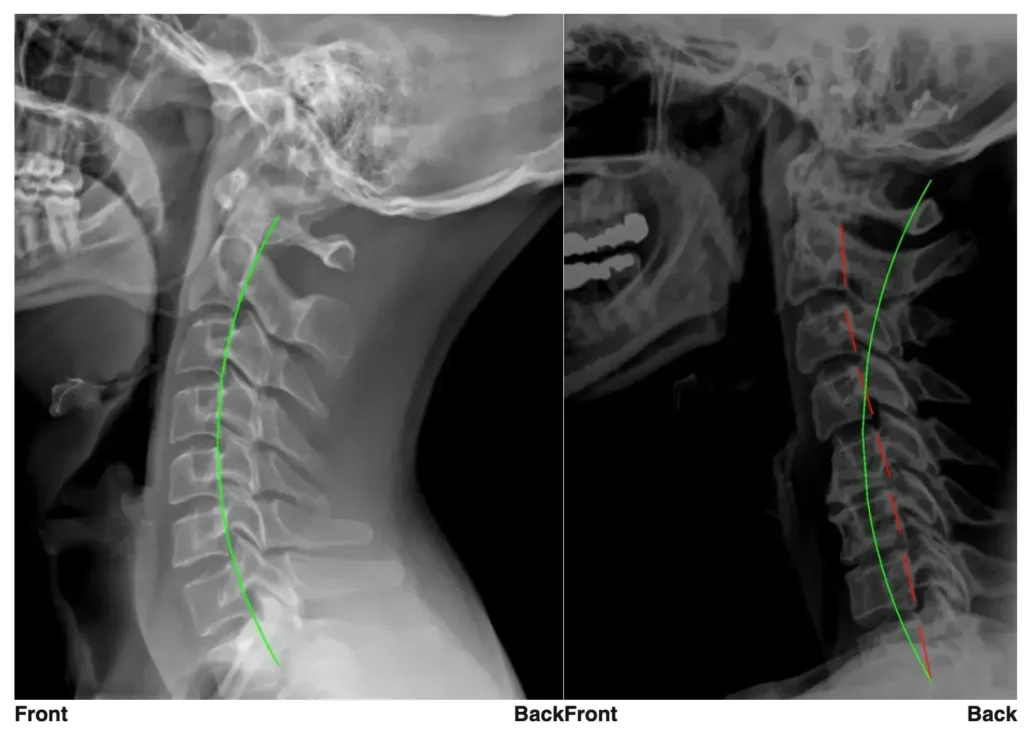
Forward head posture is one of the most common reasons people walk into our office in Sarasota. It usually starts quietly: a little tightness at the base of the skull, shoulders that creep toward your ears by the end of the workday, a headache that shows up every afternoon. Most people chalk it up to stress or a bad pillow.
What’s usually going on is more mechanical than that. Your head is sitting in front of your shoulders instead of on top of them, and your neck and upper back are working overtime all day to hold it there.
What Is Forward Head Posture?
Your head weighs roughly 10 to 12 pounds. When it sits directly over your shoulders, your spine carries that weight efficiently. As it drifts forward, the load on your neck climbs quickly. A common estimate is about 10 extra pounds for every inch forward.
At an inch and a half forward, one of the most common findings on our X-rays, your neck and upper back may be handling 25 to 30 pounds of sustained load every single day.
Phones, laptops, long drives and desk work all pull the head forward. Over time the muscles at the back of the neck stay locked on to hold your head up, the deep muscles in front get weak, and the natural curve in your neck starts to flatten or even reverse.
Signs Your Posture Might Be Part of the Problem
- Headaches that start at the base of the skull
- Neck and upper back tightness that comes back no matter how much you stretch
- Rounded shoulders or shoulders that sit high
- Tingling or numbness in the arms or hands
- Feeling tired or foggy by mid-afternoon
- A visible hump at the base of the neck
Any one of these on its own isn’t cause for alarm, but when several show up together, it’s worth a closer look.
Why It Gets Harder to Fix the Longer It Goes
Forward head posture tends to be progressive. When the neck stays out of its normal position for years, the ligaments adapt to that position, the discs take uneven load, and the joints can start to show wear. The earlier it’s caught, the more room there is to correct it conservatively.
That’s why we don’t guess. Every new patient gets digital X-rays and a PostureRay report so we can measure exactly how far forward your head sits and what your neck curve looks like.
Watch: Forward Head Posture Explained
In the video below I walk through what forward head posture does to your spine, including a quick self-test you can do at home right now.
How We Correct Forward Head Posture
Stretching and posture reminders help, but on their own they rarely change the structure. Our approach goes after the structure itself:
- Corrective chiropractic adjustments to restore motion to the joints that have locked up in the forward position. Learn about our corrective care.
- Denneroll cervical orthotic sessions to help retrain the curve in your neck over time.
- Targeted strengthening for the deep neck flexors and upper back so the new position holds.
We re-check your posture along the way so you can see progress, not just feel it.
Questions We Get About Forward Head Posture
Can forward head posture actually be corrected?
In many cases, yes, especially when it’s caught early. How much change is possible depends on your age, how long it’s been there, and what your X-rays show. That’s why we measure first.
Will a better pillow or desk setup fix it?
Those help, and I’ll give you specific recommendations, but they mostly keep things from getting worse. Changing the structure usually takes more than ergonomics.
Do kids and teens get forward head posture?
We’re seeing it earlier than ever because of phones and tablets. The good news is that younger spines tend to respond well. Learn more about how we work with kids and teens.
Get Your Posture Checked in Sarasota
If your head feels heavy, your neck is always tight, or you’ve noticed your posture changing in photos, it’s worth finding out where you stand. Schedule a visit with Dr. Alex Lee at Circadian Chiropractic & Sport, at the corner of 17th & Honore.