
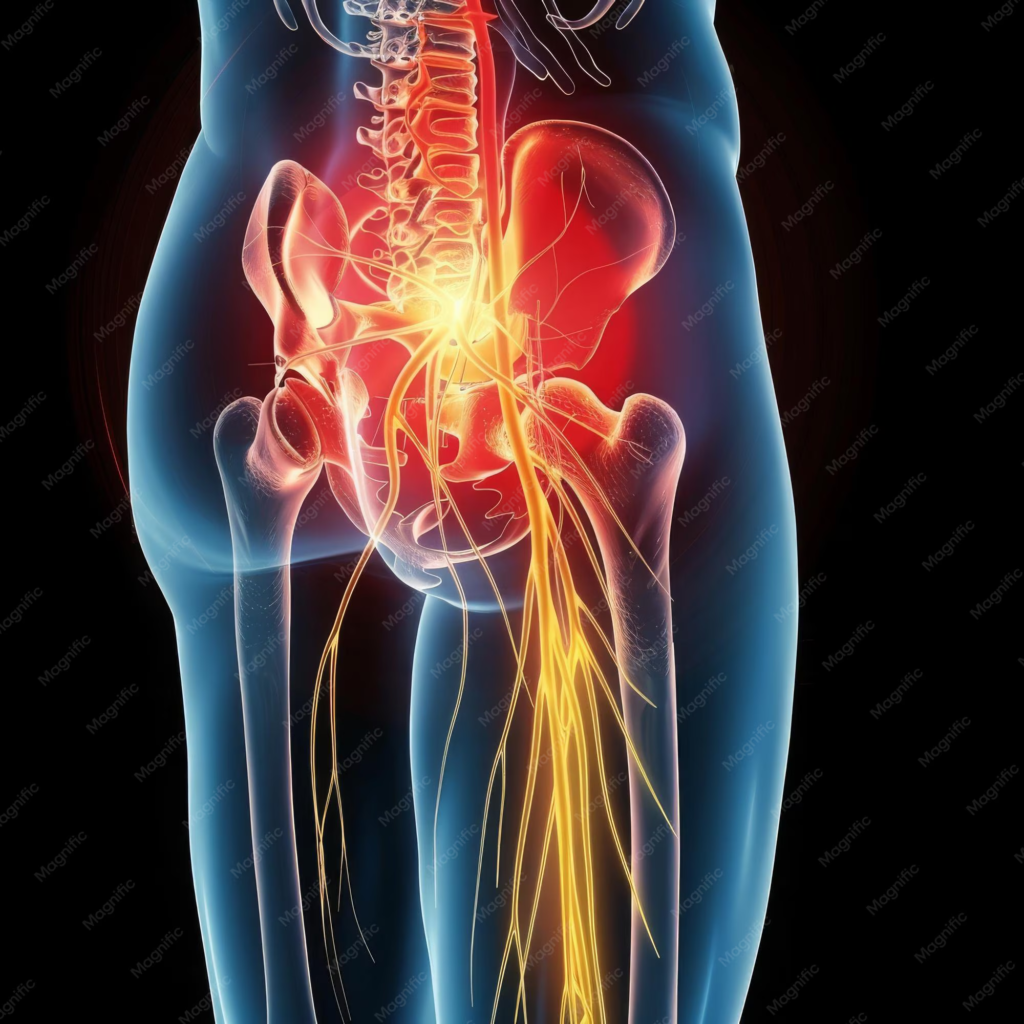
I play most weekends at Meadows, and I hear the same thing on almost every tee box: “My back’s been bugging me.” Usually it’s said with a shrug, like back pain is just part of the price of playing golf in Sarasota year-round.
It doesn’t have to be. But the fix usually isn’t another stretch on the first tee or a new driver. It starts with understanding what the golf swing actually asks of your lower back.
The golf swing is a rotation sport played by a spine that hates rotating
Your lower back (the lumbar spine) is built mostly to bend forward and back. Each segment only rotates a few degrees. Your hips and your mid-back are supposed to do the heavy lifting on rotation.
When your hips are tight from sitting, or your mid-back has rounded forward from years at a desk, the rotation has to come from somewhere. Very often it comes from the lower back, a few degrees at a time, thousands of swings a season. The discs and joints at the bottom of the spine take that load.
That’s why I think of the lower back as the victim, not the cause. I saw the same pattern for years with pitchers: the arm got hurt, but the problem started somewhere else in the chain.
Three patterns I see in golfers’ backs
- Early extension. Your hips thrust toward the ball on the downswing and your spine straightens up. It’s often a sign that your hips or core can’t hold your posture, and it jams the joints in your lower back.
- The “reverse C” finish. That big backward lean at the finish looks athletic, but it compresses the back of your lower spine at speed. Many older swing models taught it; most coaches now avoid it.
- All arms, no hips. When the hips don’t turn, the lower back and shoulders twist harder to make up the difference. You might notice your back tightens up more on the back nine as you fatigue.
A good teaching pro can help you clean these up. What a lesson can’t tell you is why your body is making those compensations in the first place.
What we check in a golfer’s spine
Every new patient at Circadian starts with a Day 1 Spine & Nerve Exam. For golfers, I pay extra attention to:
- Rotation side to side. Most golfers turn noticeably better one way than the other. We measure it.
- The curve of your lower back and the position of your pelvis, using full-spine digital X-rays and our PostureRay report.
- Disc height at each level of the lower back. Discs that have lost height can’t absorb rotational load as well.
- Muscle activation. With NeuFit, we can see which muscles in your hips and core have stopped firing the way they should, which is often why your back is doing their job.
On Day 2, you get a report of what we found and, if we can help, a plan built around getting you back to playing without paying for it the next morning.
What helps (and what usually doesn’t)
What usually doesn’t last: stretching your hamstrings on the range, a couple of ibuprofen at the turn, and resting it for a week. They can take the edge off, but they don’t change how your spine is aligned or how it moves.
What may help, depending on your exam:
- Chiropractic care focused on the position and condition of your lower back, hips and mid-back, so rotation comes from the right places.
- Non-surgical spinal decompression if your X-rays or exam suggest a disc is involved. It gently creates space between the vertebrae to take load off the disc and the nerves around it.
- NeuFit to get the glutes and core firing again, so your hips can hold your posture through impact.
For more on how we approach the lower back, see Lower Back Pain Relief in Sarasota.
A quick self-check before your next round
Sit on a chair with your arms crossed over your chest. Without letting your hips move, turn your shoulders as far as you can to the right, then to the left. If one side is noticeably shorter, or one side pinches in your lower back, that’s worth having looked at before it becomes a problem that takes you off the course.
Sarasota golfers, start with an exam
If your back is the reason you’re skipping the range, riding instead of walking, or dreading the drive home, it’s time to find out why. Schedule your Day 1 Spine & Nerve Exam or call (941) 259-2229. We’re on the corner of 17th Street and Honore.
– Dr. Alex Lee, DC

About Dr. Alex Lee
Dr. Alex is a Life Chiropractic College West graduate and former D1 baseball player who owns Circadian Chiropractic & Sport in Sarasota, Florida. He helps families and athletes in Sarasota, Bradenton, and Lakewood Ranch.
new patient special
$47 new patient exam
Consultation, full exam, X-rays (if necessary), your first adjustment, a report of findings, and care recommendations.
$47 new patient exam is for cash-pay new patients. Not valid for insurance-billed, Medicare, Medicaid, or auto-injury/personal injury visits. The patient and any other person responsible for payment has a right to refuse to pay, cancel payment, or be reimbursed for payment for any other service, examination, or treatment that is performed as a result of and within 72 hours of responding to the advertisement for the free, discounted fee, or reduced fee service, examination, or treatment.